
When Baseball Went to the Moon
Baseball went to the moon with the same technology that revolutionized the fan experience over 40 years earlier.

My grandfather was a great baseball fan who was 16 years old when the American League began play in the spring of 1901. He lived in a part of Michigan that was closer to Chicago than to Detroit, and he had been a fan of the Chicago Colts — now known as the Cubs, but he immediately adopted the new league’s Detroit Tigers as his team and rooted for them the rest of his life.
In sharing with me his life as a fan of the Tigers, he explained how that relationship went through a radical and immensely meaningful transformation in the late 1920s that greatly enriched his bond with the team. The heyday in the history of the Tiger franchise was from 1907 to 1909 when they won three straight pennants and featured the greatest player of several generations in the perennial batting champion and audacious base runner, Ty Cobb.
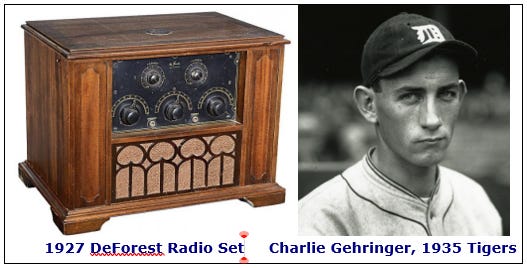
Yet my grandfather had a muted affinity for those great Tiger teams, which he knew only from newspaper stories, and that news tended to come late to western Michigan. His world as a baseball fan changed dramatically in 1927 when the Tigers began broadcasting their games on radio, station WWJ, which was owned by the newspaper The Detroit News. He had now moved closer to Detroit, and at 85 miles out, he was in the limited 100-mile range of the station. So, he broke down and bought his first radio. His wife and two children delighted in the luxury as well, but for my grandfather it was all about baseball. That first year he listened with awe to about 25 games. (The station only broadcast home games, and he could not listen to the games during his work week because they were, of course, played in the afternoon.)
Now, all of sudden, there was a startling immediacy to the games. Something as simple as the ability to get the score of a Tigers’ game while it was still in progress was a totally new experience for my grandfather, and he relished this new intimacy with his major league team. Radio was considered such a significant phenomenon that in the 1930 census, for the first and only time, one of the questions asked was whether a household had a “radio set.” Nationwide, the census showed that only 40% of households owned a radio. (Yes, I have seen the census form confirming that in the midst of the Great Depression, my grandfather — who was a house painter and finishing carpenter — had a radio while four of his close neighbors did not.)
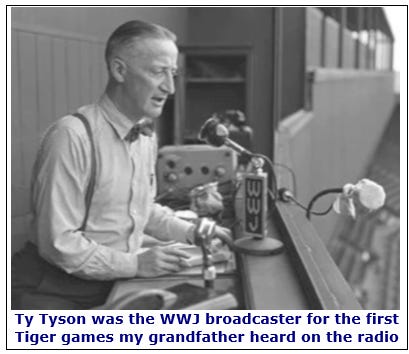
And so, it came about that my grandfather’s favorite Tiger teams were not from the glory days of Ty Cobb, but rather the strong Tiger clubs of the early and mid-1930s, especially the 1935 Tigers, his all-time favorite. Radio was the reason why.
Forty years later, with the advent of television, radio was starting to become passé, but I got to share a few moments of special wonder with my grandfather at the magic of radio tethering some very special fans to the game.
As mentioned in a recent story, I had a special fascination and interest in the early space program. Few remember today how during the Apollo 11 mission to land on the moon that the astronauts received brief news briefs about what was happening on earth during their journey, via radio from the “cap comm” (capsule communicator) in Houston. Efforts were made to include news on subjects the astronauts normally followed — one of which, for this courageous trio, was major league baseball. I remember my grandfather and I marveling at how radio had gone from those early days of linking baseball to fans a hundred miles away from the action, to keeping these three fans in touch with the game all the way to the moon, nearly a quarter of a billion miles away!
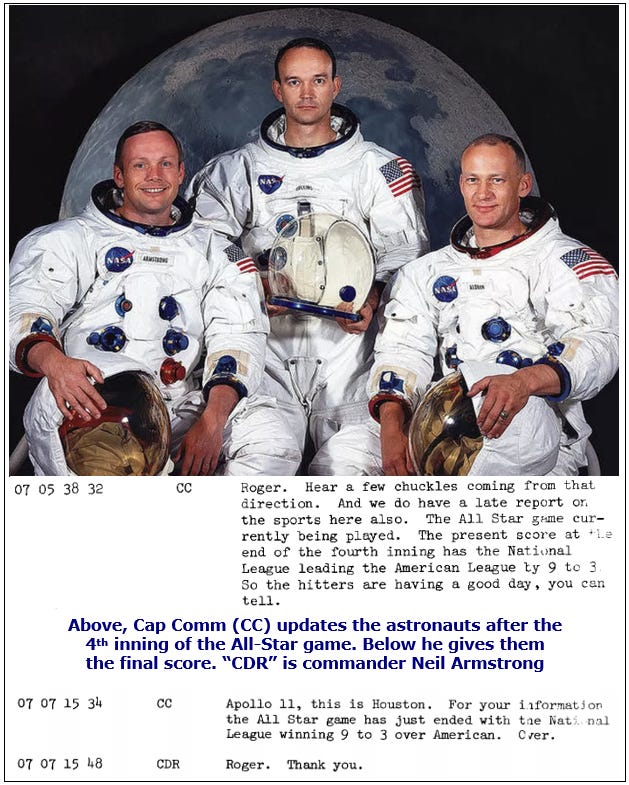
The astronauts would get updates on the pennant races and news of how the fledgling Houston Astros were doing. One day their baseball news brief did not mention a score for the Astros, and astronaut Mike Collins checked that the Cap Comm (CC) did not forget the Astros, asking, “I assume Houston didn’t play …”
Not long after leaving lunar orbit, the astronauts were dutifully informed how, “Last night in New York, the Baseball Writers Association of America named Babe Ruth the greatest ball player of all time. Joe DiMaggio was named the greatest living ball player.” And they were disappointed along with the millions of baseball fans on earth when the All-Star game was rained out on July 22nd and had to be played the next night.
Watching the 1969 All-Star game, my grandfather and I wondered if the astronauts — still on their journey back to earth — might be getting radio updates on this very game we were watching.
Decades later, reading the transcripts of the communications of the Apollo 11 mission, I was able to see that that was exactly the case. After the bottom of the fourth inning, the same inning in which my grandfather and I cheered as Tiger Bill Freehan singled in a run off Bob Gibson, the Cap Comm gave the most distant of baseball fans that update on the score. Ninety-seven minutes later the CC passed along the final score, and mission commander Neil Armstrong replied: “Roger. Thank you.” It was all part of the little moment in history when baseball went with us to the moon.
Research Notes
The Houston Astros’ first season without a losing record (they went 81-81) was the summer we put men on the moon.

In 1999, a very special guest threw out the ceremonial first pitch for the Astros’ final season in the Astrodome. He had initially declined the honor, explaining that he was at a stage in his life in which “I don’t do public events.” But he made an exception for this special occasion for the Astros. It was mankind’s first man on the moon, Neil Armstrong, who made the honored toss.
The earliest surviving tape of a radio broadcast of a full major league game is from September 20th, 1934, and is a game between the Tigers and Yankees at Navin Field (later named Tiger Stadium) and broadcast on WWJ, the station that my grandfather listened to. You can hear that whole broadcast on YouTube.
One of the reasons my grandfather was so eager to get a radio to listen to the Tigers in 1927 is that their brightest young star was a player my grandfather had played with and against in a league of “town teams” and in some baseball tournaments at the fairgrounds in Fowlerville and Howell, Michigan — Hall of Famer Charlie Gehringer. They were 19 years apart in age, but they knew each other by name, and well enough to talk baseball and kid each other about diamond shenanigans. Charlie sent my grandfather a birthday card on his 100th birthday in 1984.
While this story is naturally inspired by the Artemis II mission, which arrives at the moon today — our first return in over 50 years — it is really more about how radio dramatically changed the life of fans distant from the major league cities. My grandfather’s affection for baseball on the radio stayed with him the rest of his long life. I remember that when he and I watched the Tigers on TV in his home, he always turned down the volume on the TV and listened instead to the radio account. He loved the great radio broadcaster Ernie Harwell, whom he felt was easily the best the Tigers ever had. When I try to get others to appreciate how important radio was to the fans of my grandfather’s generation, I tell them the following story. Once I was working in baseball, it was fun to share with my grandfather the times I met this or that person associated with the Tigers. I remember telling him about having lunch with Al Kaline one spring training, and Gramps marveled, “Al Kaline, how about that!” I was surprised that his most excited response was when I told him that when the Tigers were in town, I often shared a table with Ernie Harwell for our pre-game dinner. He slapped the arm of his chair and practically shouted, “Ernie Harwell!!?!!”

With Friday being the scheduled splashdown for the Orion spacecraft, I’ll stay with this theme of baseball and exploration of the moon, and share with paid subscribers the story on how MLB brought the news of moon landing into the ballparks and how the players and fans reacted that afternoon of July 20th, 1969.
With some exceptions during the postseason, I much prefer baseball on the radio. The radio broadcast of a baseball game always feels like an old friend stopping by for a visit.