
The Other DiMaggio Streak
Joe DiMaggio's legendary 56-game streak has left one of the game's great stories hidden in its shadow.

In 1922, Rogers Hornsby set a new record for the longest batting streak by a right-handed batter (under the modern rules). On August 7th, 1949, DiMaggio passed Hornsby’s mark. Whoa, whoa, wait a minute. Didn’t Joe DiMaggio break Hornsby’s record in 1941 during his famous 56-game hitting streak? That’s absolutely correct. In 1949, it was another DiMaggio who became the second righty batter to pass Hornsby’s mark!
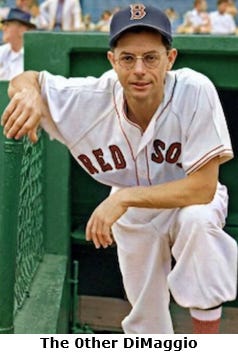
Joe’s younger brother Dominic wasn’t an elite Hall of Famer like his brother, but he was a perennial All-Star for the Boston Red Sox, and was similar to his brother in multiple ways. They were both really exceptional defensive center fielders with strong throwing arms. Both were among the fastest players, and each was a remarkably consistent hitter of historic proportion.
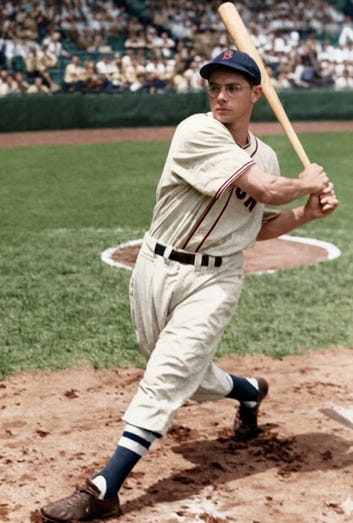
That 1949 season Dom had a 34-game hitting streak, which broke Tris Speaker’s 37-year-old record for the longest hitting streak in Red Sox history. If we exclude Tommy Holmes’ 37-game streak against the depleted pitching ranks in the war year of 1945, the last streak as long as Dom’s had been his brother’s famous streak in 1941. Here we are over 75 years later, and Dom DiMaggio still holds the Red Sox record for longest batting streak, and also the longest streak by any major leaguer wearing eyeglasses.
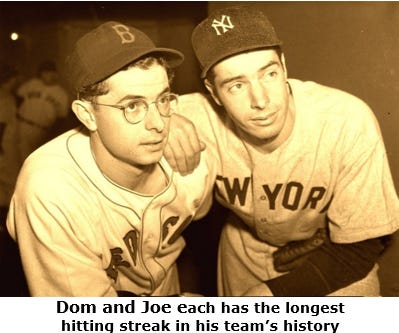
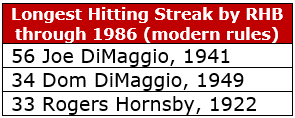
In many ways it was more impressive for Dom to fashion a long hitting streak than for Joe to do it. Dom’s career batting average is about 30 points less than that of his famous Hall of Fame brother. Compared to Joe, Dom also tended to walk more and was more likely to be called on to lay down a sacrifice bunt, costing him chances to get a hit. Dom was about 30% more likely than Joe was to have a plate appearance that did not result in an at-bat. That 30% is an absolutely huge drag on the statistical probability of running off a long batting streak.
Joe was 5 inches taller and at least 25 pounds heavier than Dom. He was over three times as likely to homer in a game, and that had been a huge advantage for Joe during his famous batting streak. A great defensive play often ends up stopping a hitting streak, but you can’t catch a ball hit into the seats. During Joe DiMaggio’s 56-game hitting streak he hit 15 homers and no less than six times his streak was kept alive by a homer being his only hit. Dom’s 34-game hitting streak never relied on a home run to keep it going.
Both Joe and Dominic had trouble hitting for average in night games, but it was distinctly tougher for Dom. In a careful study of the issue, playing under the lights had about double the negative impact compared to Joe’s case — perhaps because of Dom’s weaker vision that required eyeglasses. Making it all the tougher is that the younger DiMaggio played more when the number of night games was rapidly accelerating. Dom played in nearly seven times as many night games in the year of his streak as Joe did in 1941 (34 to 5). The hitless game prior to Dom’s streak was a night game, and so was the game in which the streak ended.
Dom also had to contend with one obstacle during his streak that Joe never did. Dom had to face the Yankees’ great pitching and defense, and in 1949 the Yankees led the league in fewest hits allowed per inning.
On June 23rd of 1949, Dom started a strong 4-game hit streak in which he went 11 for 22 (.500), but then on June 28th he was handcuffed 0-for-4 by Yankee All-Star Allie Reynolds and Joe Page, the best reliever in the league. (Dom also gave up an at-bat to sacrifice a runner over in that tight 1-run game.)
It was the next day that Dom started his 34-game streak, and when it came to an end on August 9th, it was again against the Yankees who had another All-Star pitcher starting, this time Vic Raschi. In his second at-bat Dom made his strongest bid for a hit with a line drive to center field, but his brother Joe got a good jump on it to put it away. Four innings later Dom socked a hard grounder that looked off the bat like it might be a hit up the middle, but Raschi managed to grab it and make the out. A final fly ball to brother Joe and Dominic’s streak was over.
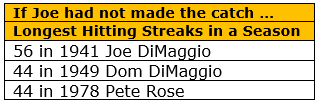
Dom promptly started a 9-game hitting streak the next day. If Joe had not caught his brother’s line drive, then Joe and Dom would have ended up ranked #1 and #2 for the longest hitting streaks under the modern rules, and the brothers would still never have been passed today.
Dom’s consistency as a hitter in that 1949 season was remarkable. What if instead of a normal hitting streak, where we count the number of games between hitless outings that we counted the longest streak between multiple hitless games? That is, during this streak, if an “O’fer” game was not preceded or followed by another hitless game, it was part of the streak. In that model of consistent hitting, Dom has the longest streak in the DiMaggio family (78 games), and not Joe who topped out at an impressive 75 games.
In 1951 Dom scored another point in his favor as arguably being a more consistent hitter than even his brother. Dom DiMaggio had a 27-game hitting streak that season, which at the time was the third longest streak in the history of the Red Sox, behind Speaker and Dominic himself. It also gave Dom a longer second-best hitting streak compared to his brother Joe, whose next best streak was only 23 games long (1940).
Research Notes
During Joe DiMaggio’s famous streak he hit in 57 straight games if you count the All-Star game. He nearly went hitless, starting off 0 for 3, but in the eighth inning he doubled off Claude Passeau. A special treat for Joe was that he was then driven home by his younger brother Dominic, who singled in the first All-Star at-bat of his career.

The oldest of the DiMaggio brothers, Vince, focused more on hitting for power than batting average, and had a career average of just .249. It is no surprise his longest hitting streak was quite short, a dozen games. Interestingly, it came in 1941, the same year as brother Joe’s 56-game streak.
To calculate the impact of night games on their batting averages, for each season they played in night games, I projected their batting average in day games that year into their night-time ABs, and compared the career totals. It was -20 points for Joe and -40 points for Dom. I was considering adding a road adjustment for the years their home parks did not have lights. Yankee Stadium added lights in 1946; Fenway Park in 1947. All their night-game ABs before those seasons were on the road. But a relative adjustment between the two wasn’t necessary as the amount of their career night-game ABs that came from such seasons was near identical (13.3% for Dom and 12.8% for Joe). The negative impact on batting average from playing under artificial light was, about double for Dom what it was for Joe.
“I just want to say one word to you. Just one word. … Plastics.” In the classic film The Graduate that is the line used by a party guest to urge college graduate Benjamin Braddock (played by Dustin Hoffman) to work in the plastics industry. Well, that’s what Dom DiMaggio did when he retired from baseball. Plastic manufacturing was still relatively new with an expansive future, and in 1953 Dom and two partners bought the American Latex Fiber Corporation. Dom eventually bought out the two partners and expanded the business by buying a second company, and created Dom DiMaggio Incorporated, which made synthetic carpeting and polyethylene and polyurethane foam — which are all forms of plastic.
Dom could never match the celebrity income generated by brother Joe — who made far more money from just his “Mr. Coffee” commercials than he did in his entire playing career. But Dom became a millionaire businessman in his own right through the plastics industry. The next time you see the movie The Graduate you’ll probably remember this note because the movie also references Dom’s famous brother. The film features the classic Simon & Garfunkel song titled Mrs. Robinson but which many refer to by its line, “Where have you gone, Joe DiMaggio ...”
