
Say It Ain't Sosa
He's the only player with three 60-homer seasons, and yet it is easy to understand why he never came close to being elected to the Hall of Fame.

After the 1920 season, the news came out that the greatest hitter in Chicago, Shoeless Joe Jackson, had confessed under oath before the grand jury that he had conspired to throw the 1919 World Series. The legend goes that a young fan did not want to believe it and said to Jackson, “Say it ain’t so, Joe.” Over eighty years later, fans of the Chicago Cubs, who had once celebrated Sammy Sosa as among the most popular players in the team’s history, were dismayed by growing rumors that Sammy had been “cheating” through most — if not all — of his star seasons. He had been taking advantage of the lack of drug testing to enhance his performance with strength-enhancing drugs, primarily steroids. Their apocryphal clever response was, “Say it ain’t Sosa.”
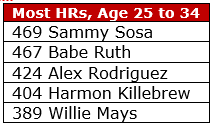
Sosa insisted he was not bothered by the rumors and believed they would not keep him out of the Hall of Fame, arguing, “Don’t I have the numbers to be inducted?” He certainly did, and Sammy knew it. He always assumed that would be his trump card for entry into the Hall, as long as he continued to deny he had cheated so significantly for so many years. Sammy was only the fifth player to hit 600 career homers. After hitting just 70 homers in over 2000 plate appearances at the start of his career, from age 25 to 34 he hit 469 homers, the most of any player ever at those ages, including Babe Ruth! Sosa is the only player to have three sixty-homer seasons, and the only one to average over 50 homers in a 5-year span — and he was closer to averaging 60 than he was to 50.
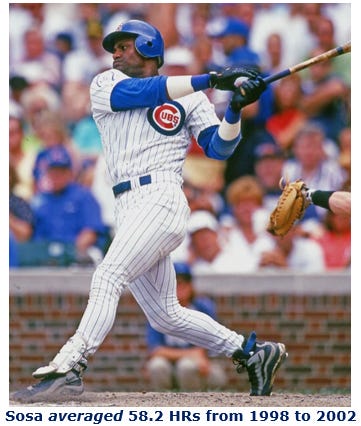
Sosa had been physically unimposing in his early big league career, carrying 175 pounds on his six-foot frame. He bumped that up to 185 pounds with normal maturation, and in 1993 he started to show some home run pop at the plate. He suddenly belted 33 homers, matching the combined total of his last three seasons. And he did it without sacrificing his batting average, setting a new personal high with a .261 mark. That may have been the start of his PED use. Such a transition would have been easy for Sosa. He spent his off-seasons in his home country, the Dominican Republic, where anabolic steroids were available without prescription. Their use was more common in the island’s boxing community than among ballplayers, and Sosa had ties to the boxing world. It was originally his favorite sport. He had aspired to be a professional boxer and at age 14 trained seriously as a boxer before giving his full attention to baseball.
Sosa looked stronger in 1994 and the Cubs reported his playing weight to The Sporting News as a new high of 190 pounds. He didn’t just improve his home run rate off his already large leap forward in 1993; he hit .300, bumping up his career high by 39 points.
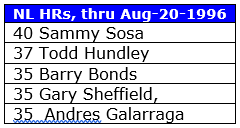
The next year (1995), Sosa nearly set another new high in HR rate, but lost it during a batting slump in the last 15 games, perhaps fatigued by playing every game for the first time in his career. In 1996 Sosa was noticeably bigger and the Cubs reported he had gained 10 more pounds. He had his first 40-homer season and that was really impressive because he missed the last six weeks of the season after a pitch broke his hand and required a surgical repair. At the time, Sosa had been on his way to his first home run crown.
Hand and wrist injuries are tougher on power-hitters, and often having a lingering, negative affect far beyond what is typical for non-power-hitters. In his first 34 games in 1997 Sosa hit just .205 with 4 homers, before bouncing back to have a decent year (.251, 36 homers). The slippage may have made Sosa think he needed to get stronger. In 1998 he showed up with yet another 10 pounds of added muscle. This was the start of the five-year run that made Sosa a legend.
He nearly doubled his homers to 66, led in both runs scored and RBIs, led in Total Bases, hit for a new high of .308, and won the MVP award. When folks suggested he might have been juicing he blew it off with a joke, crediting his huge leap forward to his “Flintstone vitamins.”
The next year (1999) the Cubs reported he gained another 10 pounds, putting him at 220. While he appeared to get even bigger in coming seasons, the Cubs reports held him steady at 220 pounds. He again led in Total Bases, and he hit 63 homers, to join fellow PED user Mark McGwire as the only players to top 60 homers in back-to-back seasons.
About this time, Sosa also began working with Dominican trainer Angel Presinal, who was known for having a number of clients suspected of using PEDs under his direction and assistance. In October of 2001, a bag believed to belong to Presinal was seized by Canadian Border Security and contained syringes and the PED Clenbuterol, which is banned in all professional sports. The next year, MLB banned Angel Presinal from every clubhouse in the majors. While it was a bad look for Sosa to be associated with Presinal, he continued to work out with the pariah trainer through at least the 2003 season.
In 2000, Sosa hit “only” 50 homers but it was enough to win his first home run crown. He also had a new career high in batting average, at .320, and tied his career high in total extra-base hits. In 2001, he had the best offensive season of his career. He set a lasting new high in batting average at .328, hit 64 homers, set a new high in extra-base hits with 103, and despite an incredible performance that year by the chemically enhanced Barry Bonds, Sosa led in Total Bases with 425, the most MLB had seen in over 50 years (Stan Musial had 429 in his spectacular 1948 MVP season.) Sammy dropped off to 49 homers in 2002, but that won the home run crown, and he won his fifth straight Silver Slugger Award. In July of that year, Sports Illustrated offered Sosa a drug test to settle all the allegations of his PED use. Sammy declined, declaring: “The whole world knows I’m innocent.”
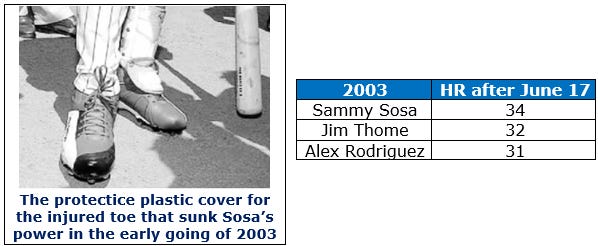
The next season (2003), Sosa was slowed in May by an injury to his big toe which had swelled the toe to twice its normal size and he had surgery to remove the toe nail. He had to wear a special protective shoe in his comeback and he struggled for several weeks after his return. Besides the 18 games he missed with the surgery, the bad toe contributed to a streak in which he hit just a single homer in 22 games. But once the toe came around, he played every inning of the last 92 games and hit more homers than any other big leaguer during that long stretch. If he had hit like that earlier in the year, he would have won another HR crown and a sixth straight Silver Slugger Award.
That 2003 season also had an incident that appeared to establish Sosa’s willingness to cheat, and caused many observers to discount his credibility in his continued denials of cheating with PEDs. By itself, it was a small potatoes matter, a minor footnote in his career, and it has generally been forgotten over the years. Yet I believe the impact it had at the time helped shape mightily the view of the future Hall of Fame voters as to whether Sosa used PEDs.