
Remembering Johnny Hodapp
Under the modern rules, the top five in batting average when actually playing second base are Rogers Hornsby, Eddie Collins, Rod Carew, Larry Lajoie … and Johnny Hodapp.

Urban “Johnny” Hodapp was the son of a Cincinnati undertaker, and a child prodigy on the baseball diamond. Johnny was only 13 when he played for the men’s team that won the city championship in 1919. At age 17 he was described as “the best shortstop ever developed here” when he joined the Indianapolis club in the American Association, one of the top minor leagues in the country. Johnny was the youngest player in the AA, playing on a team where over half of his teammates were former big leaguers.
Johnny was shifted to third base and was the only teenaged regular in the league. The kid led the team with a .343 average and The Sporting News raved: ”Young Johnny Hodapp, the biggest find of the Association season, … is burning up the league and appears to be a veritable golden nugget.” John McGraw of the Giants predicted that Hodapp would “prove to be a star in time” and tried to buy the teenager’s contract for $30,000, but Hodapp’s Indianapolis team decided to wait a year in hopes of driving up the price.
After spending his winter driving a hearse in the family business, he had a fine spring training where it was reported: “The manager of every major league team which played the Indianapolis club down in Florida raved about the Hoosiers’ third baseman.” When the season started, Hodapp hit a slump early on, but eventually shook it off and had his average up to .279 in August when the Cleveland Indians paid dearly — $40,000 and three ballplayers — for Hodapp’s contract.
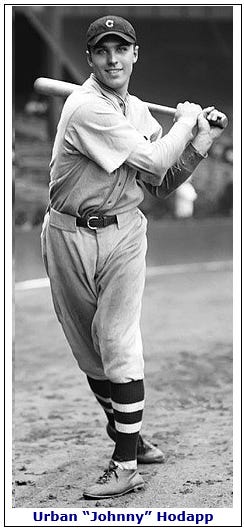
In 1928 Hodapp started all of the first 44 games and was hitting .297 and on pace for over 100 RBIs. He was also starting to show signs of being a very good defensive third baseman. He was error-prone, as were most 22-year-old third sackers, but he was showing great range in the field. He was comfortably leading the league in assists and chances fielded cleanly. But then Johnny severely injured a knee and was out of the lineup for more than five weeks. Still, when he returned to the lineup he was a better hitter than ever, hitting .339 the rest of the way.
In early September Hodapp was collateral damage to the <front office politics> played by general manager Billy Evans and field manager Roger Peckinpaugh, who had it in for the team’s star shortstop Joe Sewell. They decided, in the face of all the evidence to the contrary, that the 29-year-old Sewell was no longer a capable shortstop and had to move to third base, the only position Hodapp had played in his young career. That move would hurt Hodapp in a variety of ways in the coming years. For the remainder of the season Johnny was shifted to first base, a waste of his skills as an infielder.
When Hodapp was told he would remain at first base for 1929, competing for playing time with the team’s best hitter, Lew Fonseca — who would win the batting title that year — Johnny was so disgusted he threatened to quit and run the family’s funeral home business unless he was protected with a huge raise. He held out deep into spring training and was the last Indian to sign and report. Then in his very first infield practice he came up with a grounder at first base and in his turn to throw to second base he severely wrenched the same knee he had injured the previous summer.
By the time Hodapp was able to play again, there was no place for him in the lineup. Lew Fonseca was having a career-year at first base, and the club was adamant about not returning Joe Sewell to shortstop and opening up third base again for Hodapp. So, one of the great young talents in the game was reduced to just pinch-hitting for the whole first half of the season! Then it was decided that the only way to get Hodapp back into the lineup was to convert him into a second baseman. It was a completely foreign position for Johnny. In his professional career as a ballplayer he had played 345 games at third base, 17 at first base, and zero in the middle infield. More important, Hodapp had a bum knee that was susceptible to repeat injury, and no position on the field was more vulnerable to knee injuries than second base.
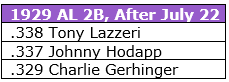
On July 10th Hodapp played his first inning at second base in his pro career, and just four days later he became the club’s regular second baseman. He did reasonably well in the field, but he was so focused on playing the new position that his hitting initially suffered. He quickly regained his comfort zone as a hitter and beginning with July 23rd, he ripped the ball the rest of the season at a .337 clip and led the team in RBIs in that span. In that period he trailed by only a single point the Hall of Famer Tony Lazzeri for the highest average by an AL second baseman, and was ahead of the league’s other Hall of Famer, Charlie Gehringer. Not bad for a kid who was still only 23 years old!
This does not suggest Hodapp was suddenly the same all-around caliber as Lazzeri and Gehringer. Johnny still had a lot to learn about playing second base. Defensively, he was very poor on his double play pivot, though he had shown good range and promise to get better.
Was Hodapp’s 1929 performance just a lucky aberration? It was his 1930 season that convinced fans he was the most promising young second baseman in the game. A friendly tip from Oscar Melillo, the Browns’ fine second baseman, greatly helped Hodapp’s double play pivot. In 1930 Johnny finished second in DPs among the league’s second basemen with 106, just one behind the leader, his mentor Melillo. But it was Hodapp’s bat and durability in 1930 that caught everyone’s attention.
The 24-year-old started every game for Cleveland, and in late June briefly took over the batting lead for the batting title, riding the strength of a 22-game hitting streak. He ended up with a .354 average, the highest average by an AL second baseman that young since the great Hall of Famer Eddie Collins. Johnny’s 51 doubles tied the record for second baseman set by Hall of Famer Larry Lajoie. His 121 RBIs tied Hall of Famer Tony Lazzeri for the most by a second baseman under the modern rules. His 225 hits broke the record of Hall of Famer Rogers Hornsby for the most by a second baseman under the age of 25.
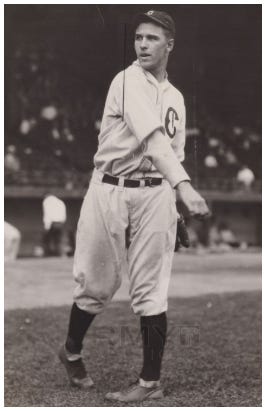
At the end of the season, Johnny Hodapp’s career average stood at .326. At the time it was the third highest average by an infielder through age 24 in as many plate appearances, behind the Hall of Famers Eddie Collins and Freddy Lindstrom. Hodapp still ranks fifth nearly another 100 years later. So why the heck have most baseball fans never heard of Johnny Hodapp?
Because that was the zenith of a short career, due to Hodapp having a “trick knee” that was likely the result of a torn anterior cruciate ligament for which, in his day, there was no medical treatment or surgical repair. And, of course, the danger of playing on that vulnerable knee was exacerbated by the Indians moving him off his natural third base position to second base, where it would be only a matter of time before repeated injuries to the knee compromised its stability, along with his ability to reliably star at the major league level.
The very next spring The Sporting News reported on an exhibition game in which: “Johnny [Hodapp] twisted to make a throw to first, only to fall in a heap and to be carried off the field by his teammates.” He missed a couple of weeks and then in mid-April he hurt the knee again on a fielding play. He came out of the game, but was back the next day. He continued to have little stumbles where the knee would collapse on him, and usually he would recover his balance before he would twist the knee badly enough to seriously hurt himself. But the little twists and wrenches of the joint took a toll. He missed 33 games and hit for his lowest average (.295) in years.
Then in the third game of the next season (1932), Hodapp was taken out by a hard slide by Jo-Jo White of the Tigers in breaking up a double play. Johnny was out of the lineup for nine days and looked bad when he tried to hit. The Indians dealt him to the White Sox where he continued to have a miserable year. He played in only 75 games and hit a weak .219.
The White Sox traded Hodapp to the last place Red Sox, and he bounced back the next year to have a fine season until mid-August. He was batting a robust .335 through August 14th, but he had gotten banged up on a play back on the 6th and had only been pinch-hitting of late. When he returned to the field, he had a stumble and his ability to turn on the ball at the plate seemed to suffer. In the next 20 games he hit .200, and the Sox took him out of the starting lineup for good for the last 24 games.
Hodapp collected a pinch-hit on September 23rd, a few days shy of his 28th birthday. It was the final hit of the once promising star in the big leagues. He was given his outright release at the end of October. Johnny continued to play in the minors but his heart wasn’t it. He played 64 minor league games, hitting over .310, and called it quits.
Research Notes
If you read the press assessments of Johnny Hodapp’s defensive skills, no matter what position he played, they tended to be harsher than what he probably deserved. It may be the syndrome that the better hitter you are, the more likely it is your defense is going to be knocked. He certainly wasn’t Gold Glove caliber, but my impression going through his career is that he was a very capable major league infielder, and that was true right through his last season, when the evidence leaned toward his being better than the other guys that Boston put out there — many of whom the press thought were better fielders than Hodapp.
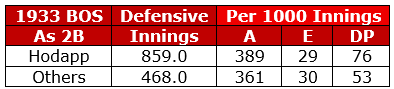

Hodapp’s batting average in his final big league season was .312, second only to Charlie Gehringer among the second basemen in both leagues. How many players — especially infielders — have done that well at age 27 and then never played in the majors again? Even with the uncertainty of Hodapp’s chronic knee trouble, it was surprising to me that the lowly Red Sox did not bring him back. The next year the Red Sox second basemen hit nearly 50 points less with an OPS 85 points worse than Hodapp had given them in his 115 games in 1933.
Besides referring to Hodapp’s bad knee as a “trick knee,” the newspapers also called it a “floating knee” and a “Leon Errol knee.” Errol was a popular film comedian known for his rubber-legged physical comedy and drunken stumbles.
Hodapp had an unusual batting accomplishment on July 29, 1928. In the second inning he singled against Yankee Wilcy Moore and the Indians batted around and he singled again, this time against Hank Johnson. In the 6th inning Johnny led off against Hank and singled. Cleveland batted around and Hodapp singled off the new reliever, Archie Campbell. Hodapp was the first AL player — and still the only — to get two hits in an inning twice in the same game! In the National League it has been done twice: Max Carey in 1928 and Rennie Stennett in 1975.

Hodapp returned to his hometown of Cincinnati to run the family’s funeral home business with his two brothers. He worked as a mortician and funeral home director for 40 years. The Hodapp family has run a funeral home in Cincinnati since 1889, and their business is still going strong today.
My grandfather was a mortician, and while my father eventually ended up being a school teacher, he was first a licensed mortician and worked with my grandfather in his funeral home in Alma, Michigan. It is possible that my father crossed paths with Johnny Hodapp back when he was graduating with honors from the Cincinnati College of Embalming, which was a premiere college of mortuary science going back to the 1880s. Johnny Hodapp was a licensed funeral director and embalmer. Given that he was a Cincinnati native and his family’s funeral home was in Cincinnati, he almost certainly received his official training in mortuary science at the CCE. If he did it post-baseball career, that would have been right about the time my father was at the CCE.

With many Opening Days happening around the majors this week, paid subscribers on Friday will hear the story of baseball’s most successful Opening Day pitcher.