
Mel Ott and the Polo Grounds
Mel Ott, a career Giant, engineered a pull swing to take advantage of the short distance down the RF line at the Polo Grounds. He hit a lot of homers there, but how much did it help him overall?

Mel Ott was a heck of a ballplayer. When he retired, he held nearly all of the career records in the National League. Most famously, by age 28 he had already broken Rogers Horsnby’s career record for NL homers. When Ott retired, he had hit 70% more homers than anyone else in NL history! Ott surpassed the league record for base-on-balls when he was 30 and retired with 57% more walks than any other NL player. And it didn’t end there. He also broke Hornsby’s NL record for extra-base hits, and he broke several of the league records that had belonged to the great Honus “Hans” Wagner — total bases, times reached base, runs scored, and the most RBIs since the modern pitching distance began in 1893.
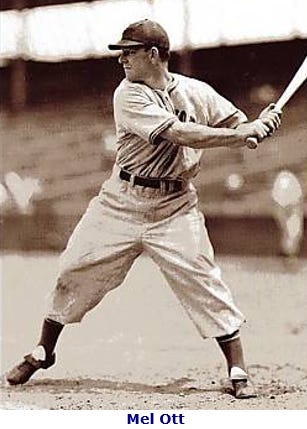
The All-Star game began when Mel Ott was already a well established star, and Mel made the first eleven All-Star teams. Ott was a regular on perennial pennant contenders before World War II. Three times his Giants won the pennant; three times they finished second, and four times they finished third. There were no scandals, no controversies. He was famously a nice guy and good with the fans. In 1937 and 1938, when the Giants had a lot of talent in the outfield, he obligingly split his time between his normal position in right field and playing third base (In those two seasons he started 171 games at third base and 127 in right field). In 1938 a cereal company ran a contest where fans voted for the most popular player at each position, and Mel was the leading vote-getter at both positions! In 1944, in a vote by war bond buyers, he was elected the most popular sports hero of all-time, ahead of even Babe Ruth.
The front office loved him as well. They kept him a lifelong Giant, and another NL record he broke of Hans Wagner’s was most games played for a single team. The club’s high regard for his character and leadership led to their making him the player-manager at age 33, and he remained in that role the remainder of his career.
That’s the resume of a first ballot Hall of Famer, right? Not in the eyes of the BBWAA of his era. Its members had already shown during Ott’s career an unusual jaundice in their view of Ott’s value. When the Giants won the pennant in 1936, Ott led the league in homers and OPS, a career-best 1.036. By the modern measure of WAR, he was the best position player in the league, but he finished sixth in the MVP voting, and fourth among the non-pitchers. So, it was less of a surprise that when they filled out their Hall of Fame ballots, they declined to elect Ott on either his first or second ballot before he gained entry on his third try in 1951. It was Ott’s home field, the Polo Grounds, that was behind their reluctance to recognize that Mel was truly one of the real greats.
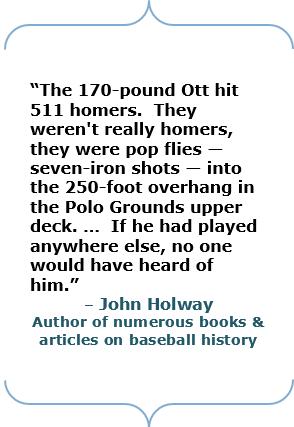
That quote from John Holway is a little extreme and exaggerated, but it does represent a view held by many fans and even some students of baseball history. The albatross around Ott’s neck is that he played in the Polo Grounds, an oddly shaped ballpark that was extremely conducive to home runs when batters pulled the ball.
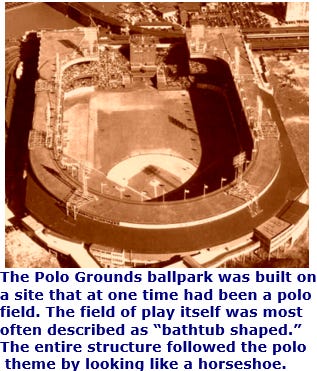
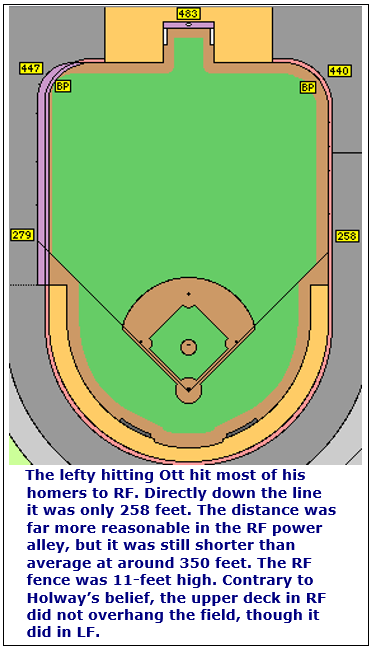
It was well known in Ott’s day that a lot of cheap home runs were hit at the Polo Grounds, and that led to the tendency to dismiss Mel’s contributions as a player due to the perception that Ott had an advantage hitting in the Polo Grounds. As far as home runs went, that was clearly the case. His home run rate in his home games was 76% higher than in his road games! Yet overall, he remained one of the league’s elite performers on the road.