
Getting to Fifty-Six
Joe DiMaggio's 56-game hitting streak is one of the most famous feats in baseball history. But like most long hitting streaks, it took a bit of luck.

Eighty-five years ago, in 1941, Joe DiMaggio was struggling at the plate in early May. The Associated Press described him as being in a “terrific slump.” In an 11-game span, he had seven hitless games and had hit .195. That reduced his overall average to .306. That didn’t sound bad for most hitters, but Joe had been the batting champion in the two previous seasons with averages of .352 and .381. DiMaggio blamed his slump on getting carried away by his hitting a mammoth 460-foot home run on April 16th. During the slump he told sportswriter Harry Grayson:
“That blow encouraged me to go for long ones. I went to bat intent on knocking the ball out of the park. This threw my timing off.”
Grayson reported that Joe was trying to bust out of the slump by “shortening his swing and concentrating on meeting the ball.” The next day DiMaggio singled in four at-bats, lowering his average another couple of points to .304, but it turned out to be a red letter day in his career. It was the beginning of the hitting streak that became the signature feat of Joe’s career.
Not only has DiMaggio’s 56-game hitting streak never been broken, no one has even remotely challenged his record. Joe, himself, never had another streak in the big leagues even half way to 56 games. His best streak before the record was 23 games and afterwards his best was only 19 games. Those who witnessed Joe’s 56-game hitting streak from beginning to end admit that the unusual length of the streak was a combination of his great ability and a good bit of luck. Joe kept the streak alive with a single hit in 61% of the games. That is the highest percentage of single-hit games among the 10 longest streaks in the Live Ball Era.
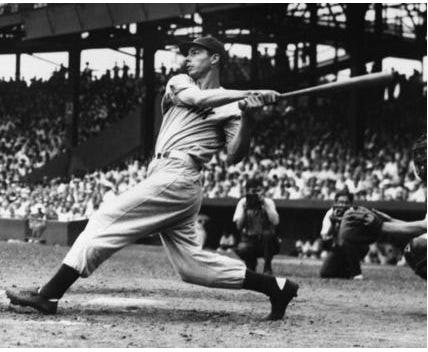
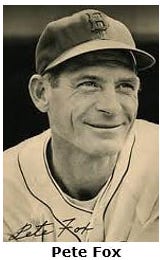
There were at least four occasions when DiMaggio’s lone hit of the game initially came off the bat looking like it would be an out. In game #16 of the streak (May 30), DiMaggio’s single hit was a routine flyball that that went for a double when Boston right fielder Pete Fox lost it in the sun.
Game #30 (June 17) was a special one for DiMaggio, as he was trying to break his tie with Roger Peckinpaugh and Earle Combs for the longest streak in Yankee history. Joe’s lone hit of the day against the White Sox started off as a routine grounder to the shortstop. Jack Smith of the Daily News (NY) reported that it was “a lucky, bad hop single.” The Brooklyn Eagle referred to it in a sub-headline as a “fluke hit” and their baseball beat writer Billy Goodrich gave the most detailed description of the hit. He wrote that it was batted “directly” at the shortstop, and that it was “… a half-speed roller [that] struck a piece of dirt and bounded lazily over Luke Appling’s shoulder into left field.” Goodrich also described the lucky hit giving DiMaggio “a foolish grin.”
In a great example of how often luck cuts both ways, In Joe’s final at-bat in this game, he socked a long ball to the opposite field where the right fielder managed to grab his potential home run. Providing the same rich descriptive detail that he gave to his Joe’s lucky solo hit, Goodrich reported: “In the next inning DiMaggio was robbed of a homer when Taft Wright speared a wicked curving liner just as it was about to fall into the right field seats.”
The next day DiMaggio again had only one hit, and while he had hit it harder than his lucky hit the day before, it was less obvious how to score it. The UPI story described it as “an infield hit off Luke Appling’s glove.” It was said that official scorer Dan Daniel hesitated, and then held up a finger to indicate a hit to the rest of the press box. It wasn’t an unreasonable ruling. Others in the press box saw it the same way, but some felt it was a call that could have gone either way.
Finally, very late in the streak, game #54 (July 14), DiMaggio’s lone hit came off one of his worst swings after having been fooled by the pitch. The UPI story reported: “Joe barely nicked an inside pitch and dribbled a roller down the third-base line so slow that [third baseman] Bob Kennedy could not field it in time to throw him out.”
In addition to the luck factor, some have wondered if DiMaggio’s streak was subconsciously helped along by the official scorers at Yankee Stadium. Most of those games were scored by Dan Daniel of the New York World-Telegram, who had befriended DiMaggio in his rookie season and was Joe’s closest friend among the baseball writers. Daniel once wrote a column titled, “My Friend — the Yankee Clipper.”
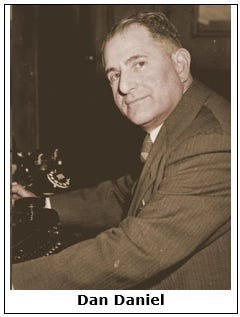
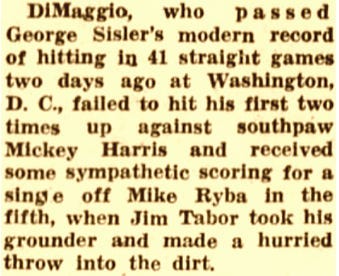
There was one scoring decision by Daniel that extended the streak at a critical time that many in the press box disagreed with. It was game #43 (July 1), the first game of a doubleheader. If Joe collected hits in both games, he would tie the major league record, the 44-game streak by Hall of Famer Wee Willie Keeler. Joe started off 0 for 2 and then he hit a grounder to Boston third baseman Jim Tabor. It was slow enough that DiMaggio had a chance to beat it out, but in swinging at the low pitch, Joe had nearly gone down on one knee, which slowed him in getting out of the box. Tabor made a low throw that got away from the first baseman and Joe went on to second base. It looked like a clean throw would have gotten DiMaggio. The crowd at Yankee Stadium was glad to have Joe safe and on second base, but their cheer was muted due to so many assuming he had reached on an error, not a hit. But official scorer Dan Daniel thought Joe would have beaten the throw and he scored it an infield hit and an error. The SABR biography on Daniel says that after he ruled it a hit, Daniel expressed his frustration at having to make the call by blurting out, “Damn you, DiMaggio. Hit’em clean!”
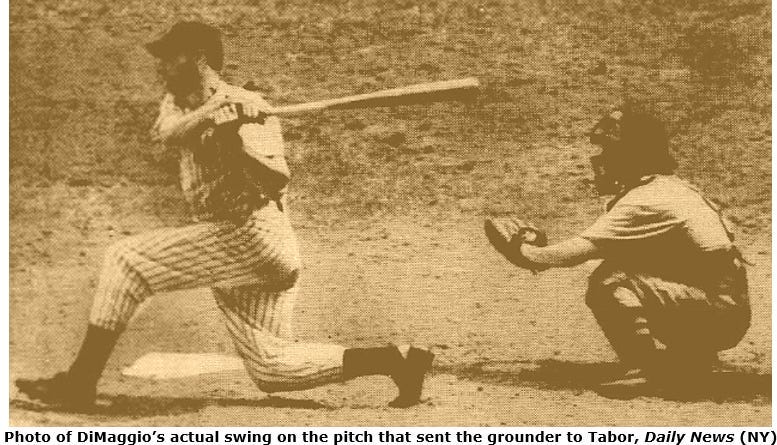
Joe went on to knock out a clean single in his 4th trip to the plate, and that made the other reporters more comfortable in publicly sharing their judgement that Daniel had been influenced by the streak in scoring the first hit.
The Boston Globe called it a “tainted rap” without elaborating. The story from the Associated Press was more clear that the “taint” was not the bad throw denying us the umpire’s decision on whether Joe had beat it out or not. The taint was in what the AP reporter judged “sympathetic scoring.”
Daniel resisted all criticism that he had favored DiMaggio with “hometown” scoring during the streak. He insisted, “I never favored him one iota and made him get his hits as I saw them.” But even if there had been a touch of hometown scoring in the streak, that temptation is as old as the records themselves. The judgment of the official scorers has been a part of every hitting streak, and yet no one has managed to approach DiMaggio’s magical 56. The real theme of this story is the reminder of how tenuous a hitting streak can be, and that in this game with so many plays dependent on what happens in the space of a few inches, that — besides great skill — a long hitting streak needs a little luck.
For example, if the routine grounder hit directly at the shortstop in game #30 does not take its huge bad hop just as it neared Luke Appling, then you can set aside all scoring questions and all the other close one-hit games, and that leaves the longest hitting streak of Joe’s career at 29 games, a streak short enough that it would probably never even get mentioned in the synopses of his great career!
Research Notes
What you never hear in stories about Joe DiMaggio’s hitting streak is how dealing with his slump directly before the streak may have given him a focus that made his famous streak possible. Trying to break out of the slump by “shortening his swing and concentrating on meeting the ball” led to Joe having what was by far the best “contact” season of his career. In a streak from his last plate appearance on June 8th to his next-to-last PA on July 26th, he went 192 consecutive plate appearances without a strikeout, the longest such streak in his career. Based on his career strikeout rate going into 1941, he would have been expected to have about 29-30 strikeouts in 1941. He instead had just 13 Ks, and for the only time in his career led the league in fewest strikeouts per plate appearance.

The second longest hitting streak in Ty Cobb’s career was 35, the most of any player’s second longest streak. George Sisler was close with a second streak of 34 in his career. In just one season (1930), Chuck Klein had two streaks (26 games each) that are longer than Joe DiMaggio’s second longest streak of his career.
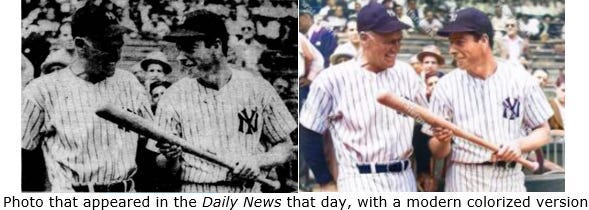
Earle Combs was there when Joe DiMaggio broke his Yankee record with the bad hop single that extended Joe’s streak to 30 games. Earle was a coach with the Yankees, and the press had the two men pose for a picture together before the game.
Based on modern accounts of DiMaggio’s streak, I had been under the impression that the lone hit in game #30 was a bad hop single that had handcuffed Luke Appling, and that the official scorer had to make a judgement call to rule it a hit. Indeed, that is the way it was portrayed in an article on MLB.com. But in researching it, I found that such remembrances are confusing that play with the infield hit from the next game. Looking at the newspaper accounts of the hit from game #30, there is no doubt that — while it was a bad hop hit — it was an obvious hit. Appling never got a glove on it, and the play could not have been scored any other way.
An interesting note from that game is that Joe got his lucky hit off Johnny Rigney, who thought this was his last game, as he had been drafted and was due to be inducted into the army two days later. But Rigney did not pass his induction physical due to a “chronically perorated right ear drum” and returned to the White Sox. (The next year, with the nation at war, Johnny volunteered for the Navy, where he served out the war.)
Oddly enough, during this hitting streak when the 26-year-old DiMaggio was arguably at his peak as a ballplayer, Joe had the worst fielding day of his career. In the second game of a doubleheader on May 30th he had the only 3-error game of his career, and he also erred in the first game, for 4 errors in one day.

Joe’s streak included a sad day in Yankee history. Lou Gehrig died on June 2nd, game #19 in the streak. The funeral was on the 4th, with the Yankees scheduled to play in Detroit. Manager Joe McCarthy and Bill Dickey — Gehrig’s closest friend in baseball — left the club to attend the funeral. As it turned out, DiMaggio and the rest of the Yankees did not have to play that day. The mournful skies opened up and rained out the game.
DiMaggio had an even longer batting streak in the minors when he was 18. He hit in 61 straight games, the longest streak in Pacific Coast League history and the second longest in all of minor league history. That streak has its own suspicions of being assisted by questionable scoring decisions after the streak reached legendary proportions. In researching the book DiMaggio: An Illustrated Life, the authors discovered that near the end of his minor league streak that Joe had had “… a series of games in which he collected single hits, many of them bobbled by shortstops, and some of questionable merit.”
If DiMaggio needed help from the official scorer during his big league streak, it was most needed in his home games. He had a single hit in 20 home games during the streak. In his road games he had a single hit just 14 times.
So, you’ve just won back-to-back batting titles and then you shatter the all-time record for the most consecutive games with a hit. Odds are you’ve won another batting title, right? Not even close. Joe DiMaggio finished third in the 1941 batting race, nearly 50 points behind the leader, Ted Williams. While DiMaggio broke George Sisler’s record for the longest hitting streak under the modern rules, George continues to hold the record for the longest hitting streak by a batting champion under the modern rules. You may have heard that Williams hit higher than DiMaggio during Joe’s legendary hitting streak. That’s true by a whisker, a fraction of a hit. Ted hit .412 over that stretch to Joe’s .408.
DiMaggio actually had a hitless game during his streak, but it was an exhibition game. On May 26th — when Joe’s streak was at 11 games and not yet noticed in the papers — the Yankees played an exhibition against their farm team, the Norfolk Tars. Jimmy Halperin walked DiMaggio in his first trip to the plate and later retired him on a pop-out to third base and a flyball to center field. Making this a less interesting note is that Joe left the game after six innings. If he had played the whole game, he would have had two more plate appearances in which to get a hit.
To keep his hitting streak going, DiMaggio had to overcome “The Kidnapping of Betsy Ann.” That’s the story paid subscribers will receive on Friday.