
Chasing the Babe
Babe Ruth's career home run record held off many challengers before it fell over a half century after he became the career leader.

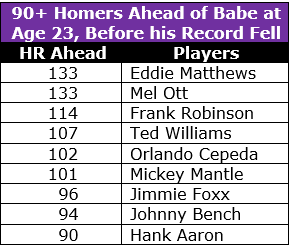
Babe Ruth became the career leader in home runs in 1921 and held that record until 1974, longer than any other player has held it. His challengers had a number of advantages in trying to catch him. Unlike Ruth, they all started off as position players and in the Live Ball Era. Several sluggers were 90 or more homers ahead in their careers through age (23), when Babe was still primarily a pitcher in the Dead Ball Era and had a total of just 20 career homers.
Yet trying to match Ruth’s 714 homers was a tremendously daunting task for several generations of players that followed him. Bill James developed a formula that looked at a hitter’s performance thus far in his career and gave a rough estimate of his chances of reaching a specific career goal. Until Babe’s record fell, there were only 19 other players who at the very best point in their careers had more than a 5% chance of hitting 714 homers.
Lou Gehrig never had better than a 17% shot. Mel Ott, who held the National League record almost as long as Ruth held the major league record, had only a 9% chance. There was no serious challenger until Jimmie Foxx peaked at a 42% shot after the 1938 season at age 30. It would be 27 years before anyone came that close again.
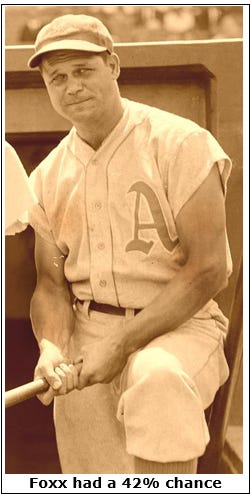
All of those who reached a 12% chance of breaking the Babe’s record ended up joining Ruth as Hall of Famers. (Hank Aaron, Foxx, Willie Mays, Mickey Mantle, Ralph Kiner, Eddie Mathews, Frank Robinson, Harmon Killebrew, Lou Gehrig, Duke Snider, and Ernie Banks.) And two more — Hank Greenberg and Ted Williams — would have likely made it 13 of 13 if not for all the playing time they lost while serving in the military in a time of war.
In the 1950s, the increased number of players swinging for the fences began to make it clear that someday the odds would overtake the Babe and produce a batter who would catch him. In 1956, for the first time, there were four players whose chances of catching the Babe had gone into double figures. Combined, there was a 64% chance that a player from that season would eventually hit 714 homers, and in fact it was nearly 50-50 that the player would be a New York center fielder.
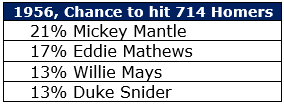
It didn’t happen. That was the peak for Snider. Mathews was already slipping from his peak of 21% the year before. Mantle climbed to a 37% chance through the 1961 season — the highest mark since Foxx back in 1938 — but eventually his chances collapsed from all of his injuries.
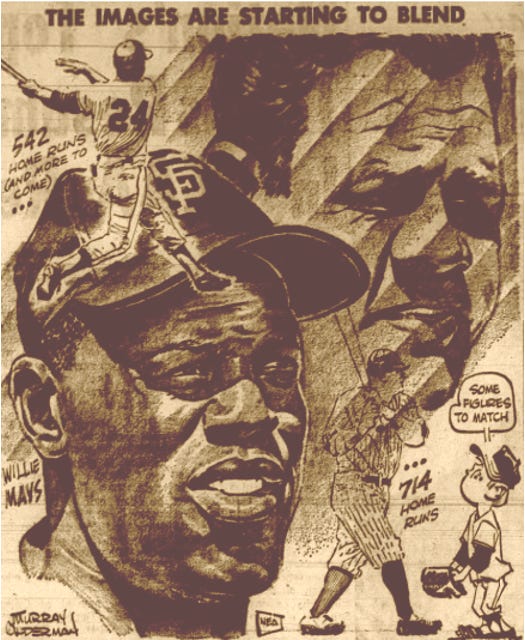
But Willie Mays wasn’t going away, and now that he was playing in the era of the 162-game schedule, his odds began to climb. After the 1965 season his odds had risen to 42%, tying Foxx’s record for the best chance yet to catch the Babe. In fact, many baseball fans at that time began anticipating that Mays would catch the Babe. In the spring of 1967, Mays’ manager Herman Franks predicted Willie would do it, and sports cartoonist Murray Odlerman did a cartoon of Ruth and Mays titled “The Images are Starting to Blend.”
But like Foxx, Mays ended up peaking out at that 42% chance, and in 1966 most believed that if Willie didn’t do it, no one else would have a shot for a long time. But that same year a change took place which radically helped Aaron improve his future odds. That Hammerin’ Hank had even a 14% chance through 1965 was actually quite remarkable for two reasons. Aaron had more reluctance than most power-hitters in regard to sacrificing the ability to hit for high average to help him hit for more power. In his 12-year career as a Milwaukee Brave, his .320 batting average had been the highest in the majors. And in Milwaukee, Aaron had a home park that was very tough on home run hitters. Willie Mays, like most players, had hit more homers at home than on the road. Hank, on the other hand, had a negative home field advantage, hitting 13% fewer homers at home than he did in road games.
That changed in 1966 when Aaron’s Braves moved to Atlanta, where a combination of higher altitude, better hitting background, and favorable wind action made it easier to hit homers. With a home park now favoring homers, Aaron became more willing to trade some points in batting average to hit for more power. And that’s what he did, sacrificing about 20 points in his relative batting average to help him hit more homers. Combined with the change in ballpark, that helped juice his relative HR rate by over 50% despite the drag from his advancing age.

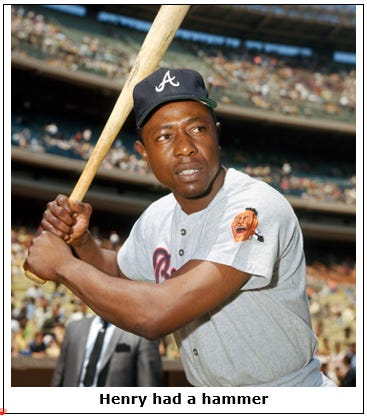
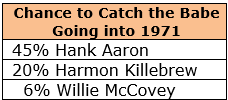
As Mays’ chances to catch the Babe faded away in the next few years, fans came to realize they didn’t need to wait for the next “Willie Mays” type power-hitter to catch the Babe. Baseball already had an even better one in the “Hammer.” By 1969 Aaron’s shot was up to 33%, and by the end of 1970 he was at 45%, the highest any player had been since the Bambino himself.
The next season (1971), after Hank hit a career-best 47 homers at age 37, the odds overwhelmingly told us to expect to crown a new Home Run King. His chance to catch the Babe had soared to 95%. It would take another two seasons and four games into a third season, but baseball finally crowned a new home run champion on April 8th, 1974.
Research Notes
The same year that Hank Aaron broke new ground with the best shot at 714 homers since Ruth himself, Harmon Killebrew peaked at 20%, becoming one of only 8 challengers to be that high at some point in their careers, joining Aaron, Jimmie Foxx, Willie Mays, Mickey Mantle, Ralph Kiner, Eddie Mathews, and Frank Robinson.

The birthdays of Babe and Hank are right next to each other. Ruth’s birthday was February 6th and Aaron’s was February 5th.
The Braves moving to a more friendly home run park in Atlanta was only part of what drove Aaron to challenge the Babe’s record. Just moving back to the South and being bombarded with racial indignities that had been muted in his time in Milwaukee woke something within him. He recalled:
“In a strange way, it seemed that returning to the South took some of the boy from Mobile out of me and replaced it with a man who was weary of the way things were. I was tired of being invisible. I was the equal of any ballplayer in the world, damn it, and if nobody was going to give me my due, it was time to grab it. It [715] was still a long, long way away, but looking back, I suppose that first year or two in Atlanta was when I made up my mind that if I ever got close to Babe Ruth’s record for home runs, it would be mine.”
As covered in an <earlier story>, before Barry Bonds first began using illegal steroid-type drugs to enhance his performance in 1999, the James’ formula anticipated that an honest Bonds would likely finish with about 585 homers. At that point in his career he had only a 1% chance of catching Aaron. Bonds’ chance of reaching his final actual total of 762 was less than half a percent. That’s why so many fans still consider Aaron the true career Home Run King.
Today, with home run rates so high for decades now, we have an astounding 28 players in the 500-homer club. Only four of these talented hitters won multiple batting titles in their career. Bonds did it after he started cheating. Hank Aaron did it, and of course Ted Williams did it. Who is the fourth guy?
As long as we are playing baseball trivia, this one is much tougher. During the chase of Babe’s career home run record, Who was the only player to peak with a double-figure chance to catch the Babe and then failed to even make the Hall of Fame.
And yet here’s an even tougher one. There was only one other player who peaked as high as 5% without getting to the Hall of Fame. Here’s a hint. He established his peak chance at the very young age of 23.
Finally, in the game in which Aaron broke Ruth’s home run record. What significant record did Aaron break in the plate appearance just before he hit #715, but which was completely lost in the shadow of his momentous home run?
Answers:
Jimmie Foxx was the first multiple batting champion to make the 500-homer club.
Rocky Colavito peaked at a 11% chance to catch the Babe after his seventh season in 1961 season.
Hal Trosky peaked at a 5% chance after his 1936 season at age 23.
In Aaron’s first plate appearance on April 8th, 1974, he drew a walk and scored when Dusty Baker doubled and the left fielder Bill Buckner mishandled the ball for an error. That run set a new National League record for runs scored. While it was utterly overshadowed that day, it was a very prestigious record, a torch passed continually among elite Hall of Famers. Leaving the 1800s, it had belonged to Cap Anson. Honus “Hans” Wagner took it over in 1917. Mel Ott passed Wagner in 1944 with an assist from the war years. Stan Musial broke the record in 1962, and Willie Mays passed Stan in 1971. Mays had held it less than three years when Aaron took the torch in his plate appearance just before hitting #715.
(What hadn’t passed hands for most of that period was the major league record for runs scored. American Leaguer Ty Cobb became the leader in career runs scored early in 1923 and held that record for the rest of the century. Rickey Henderson passed him in 2001.)
Hank Aaron had played second fiddle to Mays through nearly their whole careers. The many fans of Willie Mays — and Mays, himself — were stung that Aaron was the one who broke Babe Ruth’s home run record. The best argument for why it ended up Aaron and not Mays relates to Willie’s military service during the time of the Korean War. But actually, that time in the military may have helped Mays become a great hitter by overcoming a bad habit he was developing at the plate. Paid subscribers will hear this little known story on Friday.