Buddy Lewis
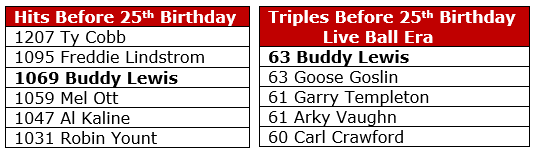
Only six players have recorded 1000 big league hits before their 25th birthday. Buddy Lewis is the only one who did not go on to the Hall of Fame.

One of the best seasons from a teenager came from a player that most modern fans have never heard of. In the spring of 1936 the expectation of the Washington Senators was that their 19-year-old prospect Buddy Lewis would move up to the Albany Senators, their top minor league team in the International League. If he somehow managed to make the big league team that spring, no one expected that he would play much. The team had a well-established infield with veterans Buddy Myer (2nd base) and Ossie Bluege (shortstop) coming off All-Star seasons, and their young third baseman Cecil Travis, was a budding star who had hit .318 in his 1000+ plate appearances in the majors.
In spring training, it was decided to move Travis to shortstop so the Bluege could move back to 3rd base where he had played most of his prior career. It didn’t help Buddy’s chances that early in spring training he dislocated a finger on his left hand. But Lewis shook off the injury to hit well enough that on March 18th it was reported that he had made the team, along with the news that a young sensation with the Yankees named Joe DiMaggio was also going to stick with his big league club. However, Lewis was more than two years younger than DiMaggio, and Buddy was seen as more of a down-the-road replacement for Bluege, who was 36 years old.
Ossie thought that day might come sooner than later after watching Lewis suck up groundballs and knock out line drives. Bluege told the press: “In the last four years we’ve had a dozen third basemen, trying to take my job, but they didn’t have a chance. I’m through now, though.” The teenager called him “Mr. Bluege” and Ossie took the kid under his wing and became his biggest booster.
Then Lewis had a 4-hit exhibition game against the Red Sox with three triples, and then another 4-hit game with another triple against the Browns, and it was decided the future was now. Manager Bucky Harris said he was counting on the teenager to be his regular third baseman in 1936. But first, to take the pressure off, Harris started Bluege in the opening series in Yankee Stadium. Then Buddy took over as the regular third baseman for the rest of the year, while being the youngest position player in the league.
The boy was a huge success and was still hitting over .300 going into September, but it had been a long season, and he was dragging in the final weeks. A late-season slump brought his average down to .291, but it remains the 2nd highest average — to Mel Ott — by a teenager in a qualifying season. And Buddy didn’t skimp on the sample size. His 657 plate appearances remain the record for a teenaged regular. His thirteen triples led the team and they, too, remain the record for a season by a teenager, as does his 100 runs scored and his hit total of 175. Club owner Clark Griffith, who had been on the big league scene going back to his pitching debut in 1891, remarked: “As long as I’ve been in baseball, I’ve never seen an infielder who looked so good in his first year as a big leaguer.”
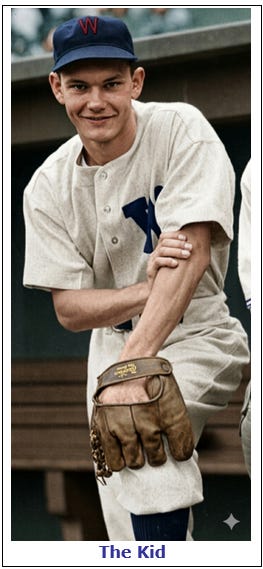
There was no sophomore slump for Lewis. At age 20 he hit .314 and led the team with 107 runs scored and 210 hits. The next year (1938) Buddy hit “only” .296 but made the All-Star team and had a strong year in the field, leading the majors in both assists and double plays at third base. In 1939, he hit .319, led the league with 16 triples, and was the top defensive third baseman as well. By the measure of WAR the 22-year-old Lewis had the 8th best season among the league’s position players. In 1940, the Senators wanted to move shortstop Cecil Travis back to third base, and Buddy obligingly moved to right field. He hit .317 and with his powerful throwing arm led the league’s right fielders in assists. He asked to stay in right field the next year, hit .297, and again led the position in assists.
When Buddy celebrated his 25th birthday on August 10th of that 1941 season, he had already racked up 1,069 hits in the majors, the third most in history through that age, and 85 years later no one has surpassed him. There are only six players in history who have collected 1000 hits before their 25th birthday, and they are all Hall of Famers except Buddy Lewis.
Besides looking like a future member of the 3000-Hit club, Lewis had a running start on catching Hall of Famer Pie Traynor for the most triples in the Live Ball Era. At the same age, Traynor had only half as many triples as Lewis, and to this day, no one in the Live Ball Era has had more triples than Lewis through their 25th birthday.